24hr Project: Homemade Krupnik

Krupnik is one of those products that see in tons of bars, but keeps a low profile. It's got a really old school label, straight out of Eastern Europe - appropriately, it's hugely popular with Edinburgh's growing Polish community - but people only seem to know two things: a) it's vodka based, and b) it's honey flavoured. That's not even unhelpful.

It is a tasty product, though, and a recent article on money-saving Christmas gifts in the Guardian got me thinking.


Bottle some Krupnik

Give a bottle of home-made Christmas Krupnik. Henry Besant, founder of worldwidecocktailclub.com suggests this recipe. Buy a bottle of the best Polish vodka you can afford and pour the contents into a saucepan. Add 500ml of runny honey, 2 cinnamon sticks, 3 cloves, a teaspoon of grated nutmeg and an opened vanilla pod and heat gently until the honey is completely dissolved. Simmer for 20 minutes (but do not allow it to boil). Let the mixture cool and then strain it through muslin into a bottle of your choice. Decorate with ribbon and a cinnamon stick around the bottle neck, and add a tag with a serving suggestion, such as: "Serve with warmed cloudy apple juice and a dusting of nutmeg; add a dollop of double cream for a richer alternative."

Not only does this make a handy gift, it's just about perfect for the upcoming spice-themed MxMo. Coaxing the flavour from spices into room-temperature liquids can be troublesome, so getting that flavour extracted before kickoff could be awesome. Another bonus is the simplicity of the recipe - no macerating citrus peels for two weeks, people; instant results!

I opted for the above recipe, more or less verbatim. The thing I changed was the honey. In the end, I used three different varieties: acacia (light, floral), manuka (heavy, medicinal) and blossom (somewhere inbetween). The acacia honey keeps its liquidity naturally, so I picked a 'runny' pack of the blossom, leaving the heavier, more solid manuka to provide some bass. The other key ingredient was, of course, the vodka. I already had a bottle of Sobieski Vodka on a shelf thanks to an old colleague, and not being a prolific vodka drinker, it wasn't doing much.

Making the liqueur couldn't be easier. 

  1. Pour vodka into a largish pan.
  2. Heat gently and add the honey.
  3. Add spices (3 sticks of cinnamon, 3 whole cloves, 1.5 barspoons ground nutmeg, 1 vanilla pod).
  4. Simmer for 20 minutes - don't let it boil; we're not looking for another distillation.
  5. Strain through muslin, bottle and stick it in the fridge.
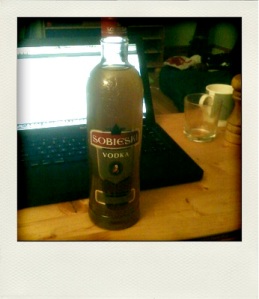
Homemake KrupnikThere are things I'm disappointed in: the colour, for one. The blossom honey is pretty dark and combined with the manuka, it makes the whole thing look kinda murky. Still, it shows a lovely amber glow when you hold it up to the light and if I had any skills in clarifying liquids, I'm sure I could clean it up further. I'm also pretty sure that I put too much honey in the mix; the final liqueur is maybe just a shade too sweet for me.

On the plus side, it tastes phenomenal. The first thing that hits is the honey, with all the depth of flavour that comes from the different varieties. That's followed by a strong cinnamon finish, with a hint of cloves lingering around after. I think it might be the manuka, but this batch reminds me a lot more of Drambuie than it does of Krupnik. That's not a bad thing. Not bad at all.

Update: turns out my two concerns may have been related. After sitting for a couple of days, the liqueur separated, leaving a thick greyish-brown sediment at the bottom and a lovely, clear, amber liquid at the top. That suggests that I either saturated the mixture with the honey or didn't heat it thoroughly enough to dissolve all of it. Given the sweetness and that I didn't use the 500ml specified in the original recipe (I used nearly 350-400ml), I'm going with the former. It's still incredibly sweet, which isn't necessarily a problem, but it's looking way better.
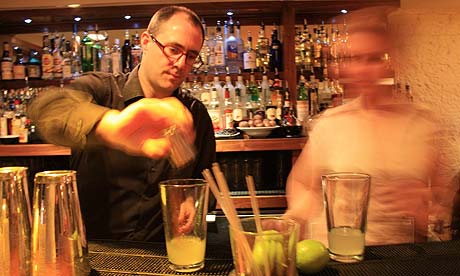
Linkdump: well hello, print media!

  The Guardians Mark Fothergill behind the stick.


It seems a pity that print media's starting to get interested in bartending and cocktailmaking just as the medium dies. Then again, they've all got websites, and you know what they say about publicity...

The Local News: the loneliest city in Britain

A BBC-commissioned survey has reported that Edinburgh is the loneliest place to live in the UK. Apparently, we're 13% lonelier than we were in 1971, as calculated by the number of unmarried adults and one-person households in the area. Is it possible that - as a city - we're not lonely, we're just crap at hooking up? It's also worth nothing that second place went to London. Yes, the one with more than 11 million residents.


It's depressing news. Given our failure to connect to our communities, I guess the only thing to do is shine lasers into the eyes of airline pilots as they attempt to land, or leave unexploded WW2 bombs lying around in school grounds.

Yes, nothing is happening in this city. It's probably why it needs £600m to ride out the economic downturn. Here are some of the stories that didn't make the cut:
  • Baby protein 'could help bowels'.
  • Mine discovered in Forth blown up.
  • Keep an eye out for albino squirrels and other ghostly sights.

Because seriously, albino squirrels will break into your house and steal your Christmas presents. And your kids.

(Lonely Old House photo from Dingbat2005's Flickr photostream. Albino Squirrel from scotsman.com)

Sunday Night Open Mic: it ain't where you're from

I'd been planning on writing a post to commemorate the 75th anniversary of Repeal Day. It's a day worthy of celebration for anyone who works with alcohol and reminds me that bartenders have an obligation to dispense spirits, liqueurs and wines responsibly. The problem is that I don't have a lot to add - US Prohibition carries more weight over here in symbolic terms rather than practical ones. My first thought had been to write about the legacy of Prohibition in terms of its effect on the culture of bartending and alcohol consumption, but Camper English wrote a great post at Alcademics.com that hit the topic right out of the ballpark. My second thought was, "it's 3am on Saturday morning, I've got a 12 hour shift starting in 8 eight hours and I haven't slept or eaten since Thursday." Sleeping is over, work is over and Repeal Day is over. We didn't have a shindig to celebrate US citizens' ability to drink booze for three quarters of a century. After all, we've been doing it for much longer in the Old World. Eastern European peasants discovered that skimming the slush off the top of a frozen barrel of mead made for a way more interesting evening. Canny Scots - I don't think they come in other varieties - hid whisky distilleries so far into the glens that the excise men couldn't find their stills to assess their tax liability. Londoners even got up to producing north of 2 gallons of gin for every man, woman and child in the capital, in a calendar year. Round here, drinking has a long and storied history. That's not to say that alcohol can't lead to societal problems, because it can and it does - there's no better illustration to that than working in a bar over the Christmas period - but it's part of the culture, as much as football (the one where you actually use your feet), talking about the weather and disliking the English. Having never had it taken away, we don't feel a powerful need to mark the occasion.

But, still, I'd missed a party. It happens, so I sat down with the Sunday papers and came across Miranda Sawyer's column in the Observer Music Monthly:

Still, who cares about gossip? There are still bands having their moment, whose small press acknowledgement coincides with a ground-swell of love from us punters, a realisation that, yes, this is music to cherish.

Obviously preferable to an Old-Fashioned

Back at university, I was music editor of the student newspaper. One of the key battlegrounds in the struggle against manufactured pop was authorship - popular music couldn't truly be authentic and therefore artistically interesting if its authorship was in doubt. For example, the awkward, vacuous sentimentalism of Starsailor's debut album would be deemed more vital to our cultural life than the entire oeuvre of Girls Aloud. This was not a bold position for student critics to take: "mainstream" was our black spot, the kiss of death, our ultimate seal of disapproval. The question of authorship would, in some cases, override all others - my review of the previously mentioned Love Is Here listed every discernible influence on the album and seemed to view the fact that they were so blatantly obvious as a good thing. I may have used the words "proud songwriting tradition".

No, I am not proud.

The point I'm digging at is this: whether you're listening to a song or a symphony, the most important question is "do I like what I'm hearing?" If the answer's "yes", then nothing else matters. So, cocktails. Bear with me.

I can't source it online, but there's a bartender themed version of the lightbulb joke.

Q: How many bartenders does it take to change a lightbulb? A: What's wrong with the original bulb? It's got 100% authentic ingredients, classic presentation - look, are you saying Edison didn't know what he was doing? It's better this way... 

Heading into work this evening, I pulled off a sales report to adjust my stocking levels ahead of next weekend. The report contains a breakdown of all of the wet (alcohol) sales in my department, including cocktails, which I always check for trivia's sake. The top three tend to swap places throughout the year, but at any given time it will contain:

  • Mojito
  • Cosmopolitan
  • French Martini

...and those three drinks will be head and shoulders above the next tier of drinks, which is made up of a couple of our original cocktails and classics like French 75s, Bellinis and Long Island Iced Teas. You have to get right into the long tail before you start seeing things like Martinis and Manhattans. Even Margaritas are rare, and Sidecars and Old-Fashioneds appear on a chart measured against months, not days.

This seems counter-intuitive, given that classic cocktails represent a huge part of my training. They are the foundation on which my  ability to make new drinks is built. Looking at their recipes and structures let me pull back the curtain and see the old guy behind it, the insides of cocktails. My thinking is so skewed towards the classics that I can tell you how to make a Gin Daisy off the top of my head, but I have to look up the Alabama Slammer.

Working behind a bar tells you that classic cocktails aren't that popular. Britain may have a centuries-old tradition of social drinking, but our cocktail tradition is much younger. But how much?

I'd guess it's about 75 years old.

Prohibition saw an emergence of a cocktail tradition, or at least the recognition of its existence, outside of the USA. It's often said that the essential American cocktails are the Martini and the Manhattan; in the UK it's probably a vodka-Coke, and there's one good reason for that. They've been doing it longer than we have.

Focusing on the history and traditions of mixology has improved product quality in the industry - Edinburgh's bartenders are creating better drinks than they were five years ago, but that focus isn't a major concern for the consumer. A successful bar is one that makes money, regardless of how intimately its staff know Jerry Thomas. Manhattans might have the heritage, but French Martinis move units, and that is the ballgame.

Time to make a tenuous connection.

There's no reason to discount a drink because it doesn't fit your idea of what a cocktail should be. For every bartender who rolls his eyes and closes his mind when he discovers a drink has Malibu in it, for every mixologist who won't look at a bottle of vodka, for every bar chef who thinks a product isn't "premium" enough, try this: have a taste and ask one question: "do I like the way this tastes?"

Nothing else matters.